S1B - 2022

Monday, September 14, 2026

Magnetising Iron Bar

#Magnetizing_Ironbar 

Magnetizing a Soft Iron Bar with the Strong Permanent Bar magnet

1. When Strong Permanent Bar magnet is away, all tiny magnetic dipoles in Fe are
   oriented in different directions, with out any alignment


2. When Strong Permanent Bar magnet approaches closely, all tiny magnets align 
   in the same direction of the Permanent magnet so that all S-pole directed towards
   the N-Pole


When Strong Permanent Bar magnet approaches closely, all tiny magnets align     in the same direction of the Permanent magnet so that all S-pole directed towards    the N-Pole


Saturday, September 12, 2026

Gausse's theorem - Animation

# ELECTROSTATICS  #Gausses_theorem


Gauss's Law

Gauss's theorem in electrostatics states that the total electric flux through any closed surface is equal  1/ ε₀ times the net charge enclosed 


Electric field lines from a point charge. The charge is placed at the center of an imaginary sphere ( Gaussian Sphere). Electric field lines start from  positive charge at center and penetrates out through the surface of the sphere.  Here All lines ( 8 lines ) are passing perpendicular to the surface, so we can Count them for FLUX THROUGH THE SURFACE.  Here flux through the surface is 8

Sunday, June 2, 2024

DHSE Physics Practicals


Cycle 3 - Physics Practical


1. Concave Mirror

Aim

1. Find focal length of concave Mirror using u - v method

2. Find focal length of concave Mirror using u v graph

3. Find focal length of concave Mirror using 1/u - 1/v graph

4. Find focal length of concave Mirror using distant object method

5. Find focal length of concave Mirror by Normal Incidence method


2. PRISM

Aim

1. Drawing i - d curve, find angle of minimum deviation 

2. Find refractive index of material of Prism


3. Convex Mirror

Aim

1. Find focal length of concex mirror using convex lens


4. Resonance Column

Aim

1. Find velocity of sound at room temperature  , Vt 

2. Find velocity of sound at zero degree celsius   , Vo

3. Find Unknown frequency of turning fork


5. Ohms Law II

Aim

1. Very ohms law, in combination of resistance 

a) In series

b) In parallel


*******************************


Cycle 2 - Physics Practical


1. MOMENT BAR

Aim

1. To find unknown mass using moment bar


2. HELICAL SPRING II

Aim

1. To find spring constant of the spring using Oscillation method


3. CONVEX LENS

Aim

1. Find focal length of convex lens using u - v method

2. Find focal length of convex lens using u v graph

3. Find focal length of convex lens using 1/u - 1/v graph

4. Find focal length of convex lens using distant object method

5. Find power of convex lens


4. LIQUID LENS

Aim

1. To find Focal length of Liquid lens


5. OHM'S LAW

Aim

1. To find Resistance of wire using Ohm's law

2. To find Resistance of wire using V - I  graph

3. To find Resistivity and Conductivity  of wire


*******************************

*******************************


Thursday, May 9, 2024

Expt1: Vernier Calipers

Write on Right Side of Page


Write on Left Side of Page


VERNIER CALIPER TEACHING VIDEO


Wednesday, May 1, 2024

Physics Practical Cycles - HSEII


 Physics Practical


  • WRITE ON A 200 PAGE NOTE BOOK
  • NAME THE BOOK AS "PHYSICS PRACTICAL ROUGH RECORD"
  • COPY THE BELOW GIVEN, 5 EXPERIMENTS AND THEIR AIMS


1. VERNIER CALIPERS

Aim

1. To find volume of rectangular block and Cylinder
2. To find Internal volume of Calorimeter


2. SCREW GAUGE

Aim

1. To find diameter and Volume of given wire
2. To find area and volume of a glass plate


3 . HELICAL SPRING

Aim

1. Find Spring constant of spring using Load -extension method
2. Draw load - extension graph and find Spring constant from graph


4. SIMPLE PENDULUM

Aim

1. To find the relation between length and Period of a simple
Pendulum.
2. Find acceleration due to gravity using calculation
3. Find acceleration due to gravity from
l / T2 graph
4. Find length of Second’s pendulum
5. Find length of pendulum having time period, 1.5 second
6. Find Period of pendulum having length 95 cm


5. PARALLELOGRAM LAW OF FORCES

Aim

1. Find mass of a given body , by parallelogram law
Apparatus


Sunday, February 25, 2024

2024 +2 Model Exam / Physics - question paper and Answer Key


Second Year HSE
Model Exam 2024

Physics
Q/A 


ANSWER KEY


Monday, July 4, 2022

PLUS TWO - CHAPTER 1 : ELECTRIC CHARGES AND FIELDS

 PLUS TWO  -  CHAPTER 1 :  ELECTRIC CHARGES AND FIELDS


DOWNLOAD CLASS NOTE


Monday, April 13, 2020

Plus 1 / S1B / Physics


Chapter 2 Units and Measurements Download class note
Chapter 3 Motion in one dimension Download class note
Chapter 4 Motion in a Plane Download class note
Chapter 5 Laws of Motion Download class note
Chapter 6 Work Power Energy Download class note
Chapter 7 System of Particles and Rotational motion Download Class note
Chapter 8 Gravitation Download Class note
Chapter 9 Mechanical Properties of Solids Download Class note
Chapter 10 Mechanical Properties of Fluids Download Class note
Chapter 11 Thermal Proterties of Matter Download Class note
Chapter 12 Thermodynamics Download Class note
Chapter 13 Kinetic Theory Download Class note
Chapter 14 Oscillations Download Class note
Chapter 15 Waves Download Class note
Previous question papers and Answer Keys Watch / Download

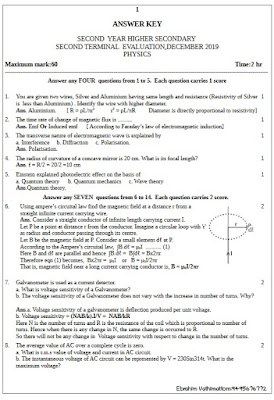
Plus 2 SECOND TERMINAL PHYSICS DECEMBER 2019 - question and answers


HSE II / +2 / PLUS 2 : SECOND TERMINAL
 PHYSICS DECEMBER 2019

Question paper and Answer key

https://drive.google.com/open?id=1fXVeVOaXU_uAuICCsyPvYkt83C15bd7s


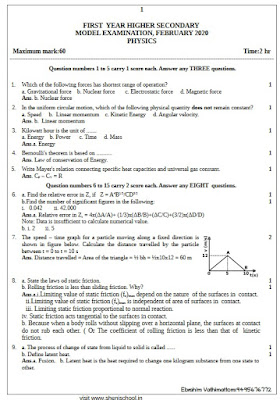
plus -1 HIGHER SECONDARY MODEL EXAMINATION, FEBRUARY 2020 - Question and Answer

FIRST YEAR HIGHER SECONDARY MODEL EXAMINATION FEBRUARY 2020

Answer key with questions

https://drive.google.com/open?id=1I4qE0h5mLT3J5TjxqPgMR0YV-912Ya7o 

Download PDF


Tuesday, March 5, 2019

Plus 1 - 2019 - Physics Model question paper and answer key

Plus 1 -  2019 - Physics Model question paper and answer key


Click to download PDF Printable file


Click to download PDF Printable file


Monday, February 12, 2018

Answer key of physics Model exam DHSE 2018

Answer key of physics Model exam DHSE 2018


Question paper of physics Model exam DHSE 2018


Wednesday, July 4, 2012

Plus 1 : UNITS AND MEASUREMENTS


CHAPTER 1 :UNITS AND MEASUREMENTS


  1. WHAT IS A PHYSICAL QUANTITY?  GIVE EXAMPLES?

Any thing that can be measured is a physical quantity.  Example : length, mass, time
Velocity, density

  1. What is a Unit?  Give examples?

Units are certain reference standards used for making measurements.
Example:  m/s, kg/ m3,  Km, Kg


  1. What are fundamental quantities and fundamental Units?
   The physical quantities mass, length and time are known as fundamental quantities.
They are called so because, Units of all other quantities in mechanics can be derived from fundamental units.  Also they can not be sub divided in to smaller units

Units of fundamental quantities are known as fundamental units.
 (meter , kilogram, second )

  1. What are derived quantities and derived units?

      Physical quantities that can be expressed in terms of fundamental quantities are
     known as derived quantities.
      (example : m/s  , m/s2, m3 )

      Note:   Two parts for measured result:
     Any measurement has two parts
  1. Its magnitude
  2. Its Unit

If we decrease the size of the unit, the numerical; value will increase.

1 Km  = 1000 m

Here Km is a large unit of length, while magnitude is 1
But, meter is a small unit of length and its magnitude is 1000

Smaller the size of the unit, greater is its numerical value.

  1. What are the characteristics of a unit , that is chosen for making measurement ?

The unit that is chosen for making a measurement should have the following properties:

    1. It must be well defined.
    2. It should be of suitable size
    3. It should be accepted internationally
    4. It should not change with change in temperature, pressure ,etc


  1. What are the different system of units ?
CGS – Centimeter, gram , second
       FPS – Foot, Pound, Second
       MKS – Meter, Kilogram, second

  1. What are the physical quantities and units in SI system?


7 Basis physical quantities  of SI unit system are

Length
meter
M
Mass
Kilogram
Kg
Time
Second
S
Temperature
Kelvin
K
Electric current
Ampere
A
Luminous intensity
Candela
Cd
Quantity of matter
Mole
mol

2 Supplementary quantities of SI system are

Plane angle
Radian
rad
Solid angle
Steradians
sr


  1. Define 1 meter in 3 ways ?

1)      It is 1 / (107) th of the distance from north pole to equator of earth

1 meter - old definition


2)      1 meter is the distance between two lines marked on a Platinum-Iridium rod
Kept at a constant temperature of 273.16 K and at  1 bar pressure in the
International bureau of weights and measures at severs near Paris in France.
3)      1 meter is  equal to 1650763.73 times the wavelength of orange red light
Emitted by Kr-86 source, kept at triple point of Nitrogen.

 
Many units to measure length

1 Km = 103 m
1 deci meter = 10-1 m
1 centi meter = 10-2 m
1 milli meter = 10-3 m
1 micro meter = 10-6 m
1 angstrom = 10-10 m
1 fermi = 10-15 m


9 .   Define 1 Kg


1 Kg is equal to the mass of Platinum – Iridium cylinder of diameter equal to its height, kept at international bureau of weights and measures.


Definition of 1 Kg

Many units to measure mass

1 Kg = 1000 gm
1 Ton = 1000 Kg
1 Quintal = 100 Kg
1 gm = 1000 mg

       10. Define 1 second

(a)    1 second is the duration of 9,192,631,770 periods of the radiation corresponding to the transition between the two hyperfine levels of  Cesium – 133 atom in ground state.
(b)   1 second is defined as 1 / (86,400) th  part of a mean solar day.

Mean solar day is the average of all solar days in a single year.
    
11. Define  1 Ampere

1 Ampere is that constant current which if maintained in two straight parallel conductors of infinite length , of negligible cross section and placed 1 m apart in vacuum , would produce between these conductors a force equal to  2 x 10 -7 N


12. Define 1 Radian

1 Radian is the plane angle between two radii of a circle which cutts off on the circumference an arc equal to the radius of the circle.

1 radian

360 degree  =  2 ∏  radian
There for,  1 radian  = 180 / ∏  degree

13. Define 1 Steradian

1 Steradian is the solid angle which with its vertex at the center of a sphere cuts off an area on the surface of the sphere equal to that of a square having sides of length equal to the radius of the sphere.

Order of Magnitude

To estimate how big or small a given physical quantity , we can use the idea of
Order of magnitude.

The given magnitude is expressed as    a x 10 b

Where  ‘a’ is a number between 1 and 10

Number  ‘b’ can be +ve or –ve

If  a >  5 , then order of magnitude = b+1
If  a < =5, then order of magnitude = b

For example :

    Diameter of earth 1.28 x 10⁷ m
     Order of magnitude = 7 and it is of the Order of 107
 
     Distance between two points is measured as  7.25 x 10⁻¹⁰ m
      Its order of magnitude is 10-9  and It is of the Order of 10-9